The Trade-Off
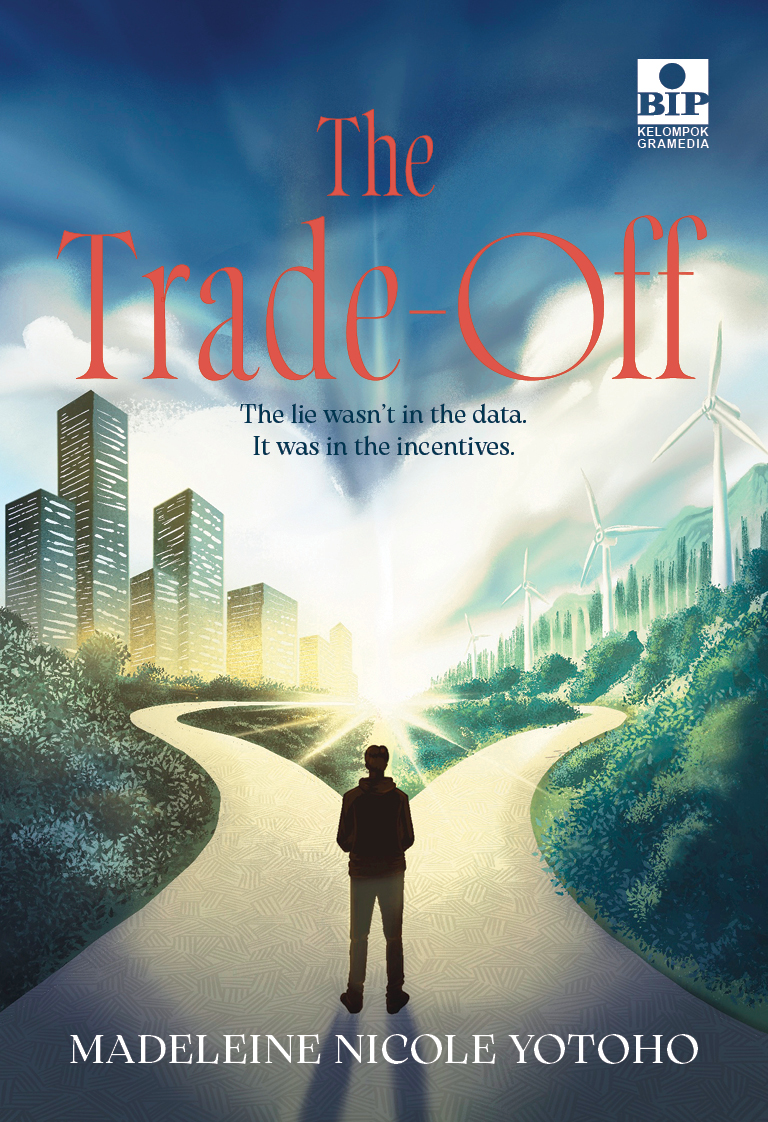
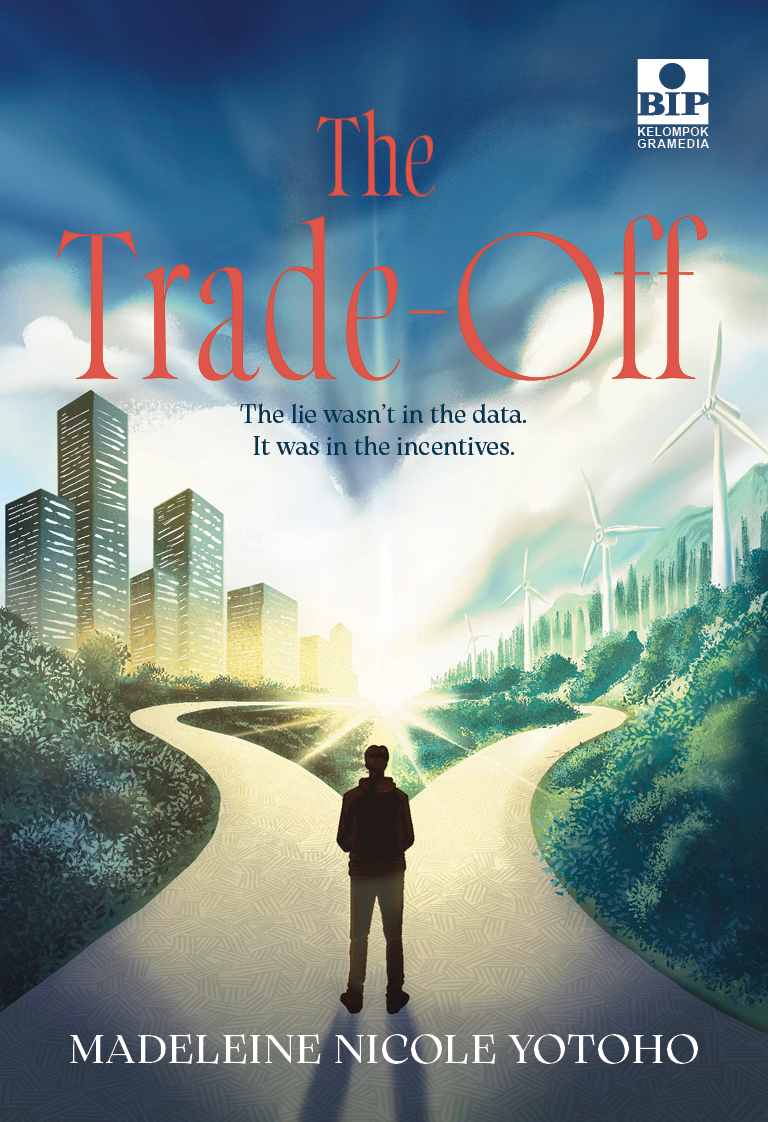
Clock’s ticking sound is heard by everyone in the room. The atmosphere around feels dizzying, choking even just thinking about what will we do. By just 48 hours, we have to hurriedly scatter to solve a fraudulent IPO that worth for $4.2 billion or there would be consequences. A group of different peoples with quirks that seems impossible to work together, can we really solve this before the opening bell?
“The Trade Off” is a financial thriller told across five cycling viewpoints; a fired engineer, a short-seller who is also the crew’s mole, a financial journalist, a disgraced ex-regulator, and a hacker with no last name on record. All of them racing to expose billion dollars fraud before the opening bell. The novel unfolds across a real-time countdown, with chapters labelled by hours remaining.
| Author | : | Madeleine Nicole Yotoho |
| Price | : | Rp 1 |
| Category | : | DRAMA |
| Page | : | 128 halaman |
| Format | : | Soft Cover |
| Size | : | 13 X 19 |
| ISBN | : | 0 |
| Publication | : |
The ambient, droning hum of the shared workspace on West Twenty-Eighth Street washed over me, a synthetic, carefully engineered cocktail of low-fidelity electronic beats and the persistent, high-frequency hiss of the commercial espresso machine. The digital clock on my display indicated it was precisely fourteen minutes past ten o'clock in the morning. I had deliberately selected a corner table that afforded me unobstructed sightlines to both the primary glass entrance and the heavy emergency exit situated to my left.
Directly above us, bold vinyl lettering stretched across the exposed brick, proclaiming another slogan about community. It felt less like inspiration and more like an epitaph for a world I had already left behind.
WeWork was built on financial storytelling as much as office space. It took a conventional leasing business, wrapped it in the language of technology, community, and disruption, and persuaded investors to value it like a platform rather than a landlord. For years, the narrative outweighed the fundamentals, driving the company's valuation to $47 billion before weak unit economics and mounting losses exposed the gap between the promise and the balance sheet.
Of all the places to meet, this was perhaps the most fitting reminder that markets eventually price substance over stories.
I kept both hands flat against the scarred wooden table, careful not to move. I knew exactly how I looked to everyone else: a woman in a charcoal sweater chosen because it required no thought, my dark hair pulled into a tight knot for the same reason.
I hadn't smiled in eleven weeks.
Eleven weeks since I walked out of Veridian for the last time.
People often mistake my stillness for composure. It isn't. The anger never went away; it simply settled somewhere deeper. Quiet anger is the most dangerous kind. It doesn't flare up or announce itself. It waits, building pressure until whatever has been holding it together finally gives way.
To my right sat Warren Osei. He was fifty-eight, unusually tall, with the permanent slight hunch of a man who had spent three decades leaning across boardroom tables while executives insisted everything was under control. His suit was immaculate but clearly a few years behind fashion—a subtle reminder of a career built on authority rather than image.
Warren had spent most of his professional life enforcing corporate governance, where the ideals of board oversight collided with the realities of executive incentives. He understood how easily fiduciary duty could be diluted when bonuses, stock options, and quarterly earnings targets rewarded the appearance of growth more than the creation of lasting value. He had watched enough companies blur that line to know the pattern almost by instinct.
When we first sat down at the table, he had simply pointed a long, rigid finger at the coffee machine and waited for me to acknowledge him. Now, he held his ceramic mug tightly with both hands, anchoring himself to the wood as if he were expecting a sudden, catastrophic loss of gravity.
“The short seller is late,” Warren observed, his slow, fatigued brown eyes tracking the movement at the front door.
“He is not late. It is precisely 10:14,” I said. My voice was entirely flat, devoid of inflection. I am constitutionally unable to utilize imprecise language, even when the adherence to such precision becomes tedious to those around me.
“The initial agreement explicitly specified an arrival window between 10:10 and 10:15.”
Right on cue, Rex Calloway materialized through the crowd. He possessed a compact, muscular build that seemed to expand the absolute moment he began to speak, an optical illusion generated by pure, unadulterated ego.
He was forty-one years old, wearing a designer jacket that cost significantly more than my monthly rent, paired incongruously with a faded, entirely generic t-shirt. The sartorial contradiction was itself a deliberate signal, the semiotics of a man who needed us to comprehend that he possessed immense wealth while simultaneously denying us the exact figure. His compensation structure at his fund was built entirely on performance fees, a classic commission arrangement that converted the gap between his information and the market's knowledge directly into personal income. His sharp brown eyes were perfectly still, calculating hidden variables that the rest of us could not see.
Beside him sat Lena Chen, thirty-five, her dark hair still tousled from the sharp October wind outside. She was an investigative journalist, making her the group's path to the public. Without her newsroom, editorial standards, and credibility, everything we uncovered would remain nothing more than encrypted files buried on a hard drive.
Her sharp eyes moved constantly between Rex and Warren, quietly tracking who knew what, who was withholding information, and who held the real influence. Years of investigating companies had taught her that an organization's formal reporting lines rarely explained how decisions were actually made. The real power usually sat somewhere else.
People often mistook Lena's easy smile for warmth. By the time they realized she had been collecting every word, every hesitation, and every contradiction, the interview was already over—and the story was already writing itself.
“We need a baseline before we begin,” Rex said, his voice smooth and entirely unbothered, right before his mobile phone buzzed with an incoming transmission. He checked the glowing screen, his facial expression remaining utterly unreadable. “Excuse me. I have to take this.” He stepped onto the concrete sidewalk, his silhouette framed by the heavy glass doors. I watched his reflection in the window.
To Warren or Lena, it probably looked routine—a senior executive taking a call, handling another crisis, keeping the machine moving. But something about the way his thumbs moved across his phone unsettled me. A faint chill ran across my skin, the same feeling that comes before a storm breaks.
He stayed outside for four minutes.
Later, I would learn he had been messaging Carol—Hartley's closest contact—confirming that our team was together and the operation had begun.
I didn't know any of that then.
What I did know was that something had changed.
An invisible gap had opened between Rex and the rest of us. He knew something we didn't, and from that moment onward every decision we made rested on a different set of facts than his. Whoever holds the better information shapes the outcome. The rest only realize they're behind after the market has already moved.
We still believed we were working toward the same objective.

RECOMMENDED FOR YOU Explore More